Showing posts with label Election. Show all posts

Monday, January 14, 2019

From Estonia to Zimbabwe, a multicultural call for e-voting


The urge to have free, fair and credible elections in African democracies has prompted most leaders to go out of their way to seek drastic measure to achieve that quality. The 2018 general elections in Zimbabwe are a demonstration of how desperate African states need to embrace e-voting system in their elections.

Envisaging the impasse in the elections, the transition government led by President Mnangagwa reached out to Estonia in search for help in exploring the possibility of implementing an e-voting system. This was a strategy aimed at enabling Zimbabweans who were living in the diaspora to take part in the national elections from the comfort of their destinations.

A timely solution for the diaspora

There had been a long clamour by the diaspora-based Zimbabweans demanding an opportunity to exercise their democratic right, even when they are away from their country. Desperate efforts had been done but remained futile following a conspicuous lack of political goodwill especially from the former regime of President Robert Mugabe.

This has come at a time when several Zimbabweans living in diaspora had to undertake a rigorous effort appealing to the government through law courts for the facilitation of their participation in the political processes. Although this quest would not be successful after a long struggle, the agitators never relented. After the ouster of the former president from power, the effort took a different turn as the current president reach out to Estonia for help.

President Emmerson Mnangagwa guaranteed Zimbabweans who inhabited in the US that his organization would investigate the likelihood of executing e-voting sooner rather than later as had been revealed by the state-run news office. Mnangagwa, in the interim, met Estonian Prime Minister Juri Ratas on the side-lines of the UNGA to examine a series of issues including how Zimbabwe could take advantage of Estonian information on e-voting.

Estonia’s online voting leadership

The agreement between the two leaders entailed that the ICT officials would be outsourced from Estonia to educate the ICT officials in Zimbabwe who would then disseminate similar education to the citizens living in the diaspora to undertake the process.

Estonia remains a hub of technology and e-voting. It has already offered guidance to help a series of countries including Afghanistan and Pakistan in curbing election irregularities during their general elections.

Estonia is in truth a pioneer with ICT advancements. In the case of Zimbabwe, the president evaluated three basic zones of collaboration with the Baltic country, e-wellbeing, e-administration, and e-voting. e-Voting is gradually becoming a solution highly sought after by developing countries to eliminate electoral fraud in their political regimes. 

Wednesday, December 26, 2018

Corruption scandal tarnishes A-WEB

Last April, former President Park Geun-hye, the first woman president of South Korea, was sentenced to 24 years in prison after having been found guilty of abuse of power. But the ex-ruler is far from being the only figure involved in this type of controversy. This year, South Korea has been the scene of major corruption scandals, which also include Kim-Yong Hi, current Secretary General of the Association of World Election Bodies (A-WEB), who is under police investigation for electoral corruption.

Kim-Yong Hi is being accused of exclusively favoring local firm Miru Systems Co., Ltd. in electoral assistance agreements signed by A-WEB under alleged "international cooperation". 

According to Kwon Mi-hyuk, representative of the Democratic Party of Korea, A-WEB and Miru System signed an illicit agreement to assist the official foreign aid projects from 2015 to 2017, when supposedly a public bidding process was to be held. However, the general secretary of A-WEB said the firm was the only one with the technical capacity to offer electoral technology in the region.

In addition to allegations of bribery, Miru is being questioned about the malfunctioning of its electronic voting devices. Their recent experience in Iraq, where the firm exported electronic voting equipment worth 135 million Dollars, ended in accusations of fraud and allegations related to flaws in the voting machines. Authorities were forced to carry out manual tallies in some areas of the country.

If that wasn’t enough, things keep getting worse for the Korean tech company. The scandal caused by the participation of Miru Systems in the Democratic Republic of Congo (DRC) elections -held on December 30- forced the former secretary of the South Korean National Electoral Commission, Kim Dai-Nyeon, to resign. In a press release he urged Kim Yong-Hi to also resign and blamed him for favoring the firm Miru Systems. 

Image by The Western Star. The DRC's Independent National Electoral Commission (CENI) showed off the device from Miru System to reporters on Feb 21.

At the beginning of November, press articles began to circulate stating that the Blue House had recommended appointing Kim-Yong Hi as a permanent member of the National Election Commission. Being a permanent member of the Commission gives the authority to determine what is right or wrong within the NEC. As a result, several representatives of both opposition parties and the government itself have been actively demanding an official explanation from the Blue House, and questioning the reasons that led it to ignore the police investigations in which the current secretary of A-WEB is involved.

Accordingly, the A-WEB office is inactive, after its budget of 4 million dollars was slashed to little less than 2 million after a NEC decision. Some representatives of the governing party have asked A-WEB's general secretary to accept his responsibility for his faults, and allow the organization to continue working, as since that budget cut many young people working for the organization were left unemployed.

Only time will tell what the future holds for A-WEB.

Wednesday, September 28, 2016

Election Performance Index: a thorough analysis of the North American electoral system


As Election Day draws nearer, poll-related studies continue to be conducted, throwing further light on the current state of American elections and the developments it had undergone.

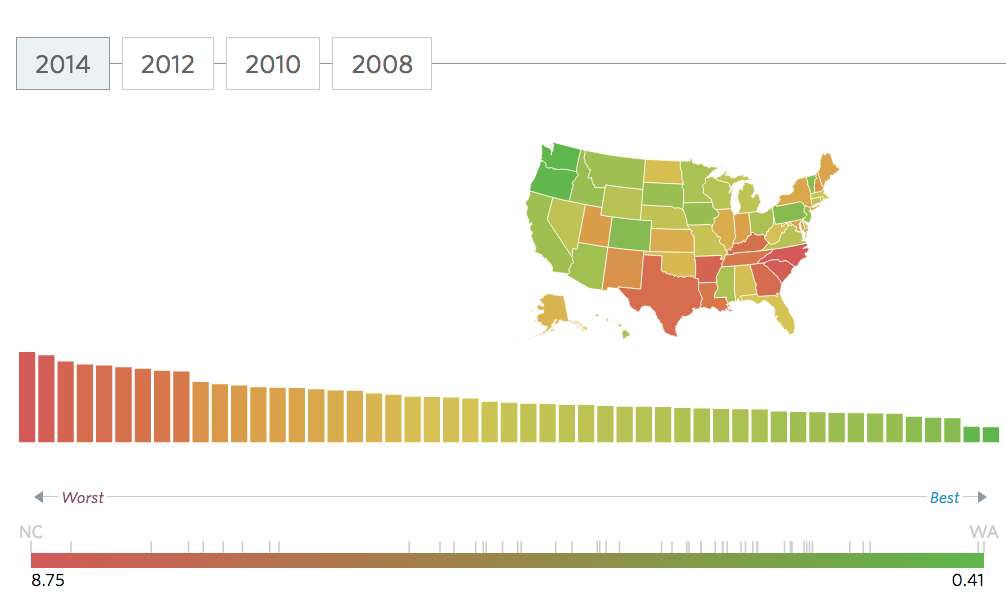
Recently, the PewTrust Research Center published the Election Performance Index (EPI), a comprehensive evaluation of the electoral system in all of the nation’s 50 states – including the District of Columbia. The study took into account 17 key indicators.

The EPI covers the 2008, 2010, 2012 and 2014 elections, measuring variables related to the problems faced by voters with disabilities, the availability of an online register, the voting of military personnel deployed abroad, voter turnout and the number of voters registered.  

These indicators reflect how several states have managed to improve their performance during elections, particularly when it comes to online registration and waiting times to vote.  

-          Online registration: Since 2008 there has been a steady increase of the number of states that offer this option to voters. This year, only two states (Washington and Arizona) opted for this technology upgrade. Today, over 20 states offer an online solution for voter registration and the update of their data.  

-          Voters with disabilities: During the past 4 elections, the District of Columbia, Mississippi and Alabama polled over 20% in the EPI when it came to voters who were unable to vote due to an illness or disability, due to the lack of proper conditions at the polling places and of solutions offered by the voting system.  

-          Voter turnout: The EPI reflects two important changes. On the one hand, during the 2008 and 2012 general elections, voter turnout did not surpass 80%, while for the midterm elections of 2010 and 2014 this index dropped to a mere 58%.  

These indicators, in addition to others in the study, show how states can continue to develop their electoral systems to offer voters more accessibility, transparency and security. These variables could be improved by the use of technology, leading to a stronger democracy. 

Monday, June 6, 2016

At least 43 states in the USA will use obsolete technology in the 2016 elections


It is estimated that during the 2016 elections at least 43 states in the USA will use voting machines that are already obsolete. In a world where technology is used almost daily, one must wonder why Americans must choose a President using devices running software from the year 2000.  

According to a study published by the Brennan Center most these machines are nearing the end of their useful life, placing the elections at risk by being prone to failures that could generate long lineups, or the loss of votes.   

Lawrence Norden,  Deputy Director of the centre and co-author of the study, wonders how one can think there are no risks  in running elections with technology designed in the 90’s. “No one expects a computer to work optimally for over 10 years”. 

The warnings in the report come at a moment when voter turnout in the US has decreased, given the long lines at the polls and the limited access certain sectors of society have to the vote.  

Before the 2016 primaries, Smartmatic – the leading elections company with experience in five continents – published a research paper that highlights the shortcomings of the American electoral system. 

The general opinion of those consulted shows that the current voting system is inefficient and discourages voters. On their part, Hispanics showed their concern about language barriers, considering that implementing new systems could increase turnout.  

These studies are just the tip of the iceberg of a subject that is gaining traction with American citizens, who see that an obsolete voting system could affect the vision their country projects worldwide about the strength of its democracy. For them, this situation could be reverted easily with the introduction of new and better technology. 

Tuesday, November 3, 2015

Azerbaijan considering electronic voting system for next election


It is not terribly common to find discussions of advancing democracy coming from countries that are perhaps more associated with communism or socialism. However, it is perhaps from these previously political states that the emergence of truly fair, free and open democracy can have among the greatest impact, as just might be the case for Azerbaijan.

The former member of the Union of Soviet Socialist Republics (USSR or “Soviet Union”) recently held its major national election on November 1. The ruling Yeni Azerbaijan (“New Azerbaijan”) party, headed by President Ilham Aliyev, was re-elected with a sizable majority, taking 71 of the 125 seats in the country's parliament. As a result, Aliyev will be leading the country for another five years.


Unfortunately, this election was not without its fair share of controversy. There have been allegations of ballot stuffing at a number of the polls, for instance, as well as the noted boycott by several of the nation's leading opposition parties. These include the National Council of Democratic Forces (NCDF), the Musavat party, and the Democratic Party of Azerbaijan. According to the NCDF, the polls in Azerbaijan are “fully falsified” and do not accurately reflect the will of the people of Azerbaijan.

A democracy cannot be fully respected and hold the legitimate seat of power if the nation's people do not trust in the integrity of the electoral process, especially when leading opposition parties boycott the polls. This leads to an inherent skewing of the results, even though voter turnout was a mere 55.7 percent.

To move the democracy forward and to earn the respect of the Azerbaijan people, the electoral process in the nation is in desperate need of reform. If the integrity of the election is not trusted, then neither can the results and this can lead to further political upheaval. Thankfully, the November 1 election was conducted in a peaceful manner with no major stories of violence.

Looking ahead to the next election in 2020, the greater possibility of a free, fair, open and transparent election is possible, one where the major opposition parties may not feel compelled to boycott. During a briefing on October 9, Azerbaijan Central Election Commission (CEC) Information Center Director Rufat Gulmammadov indicated that electronic voting technology could be suitably launched in the nation.

“If this issue is reflected in the legislation, I believe that it can be resolved without any problems from the technical point of view,” stated Gulmammadov. “If the issue of electronic voting will be reflected in legislation of the country, this corporate network can act as a platform for the launch of e-voting.”

He is referring to the corporate network of the CEC itself, which can operate as the framework for an e-voting system in Azerbaijan's national elections. The network has been in operation for more than three years and has already been used successfully in previous elections. The next major step would be for the parliament of Azerbaijan to pass legislation that would facilitate the widespread adoption and deployment of e-voting technology.

With greater reliability and transparency, an electronically-powered election in Azerbaijan may be ready for 2020. Perhaps then, the results will not be as heavily disputed and a point of rampant controversy as this most current election. 

Thursday, September 17, 2015

Improving Bulgaria’s election administration with remote voting

Discussions on the current state of democracy tend to gravitate toward regions like the United States, the United Kingdom and India, but perhaps some of the more compelling changes are happening in other parts of the world. Some of the greatest developments are occurring in places like Brazil and the Philippines, for instance, and a major referendum is set to take place this October that could change the face of democracy in Bulgaria.


To be run alongside the Bulgarian local elections on October 25, the national referendum has been reduced down to a single question from the original proposition for three questions to be included. The proposition came forth from Bulgaria's current President Rosen Plevneliev and the question that remains on the referendum is on the subject of remote electronic voting.

More specifically, the referendum question is stated as follows: “Do you support the idea to be able to vote from a distance, electronically at elections and referendums?”

Noteworthy on how this question is being framed is that it is being positioned only as a plebiscite, meaning that the result of the referendum may not necessarily result in immediate change in how future elections are run in Bulgaria. However, if the popular vote returns as a yes, it will be a clear indication that Bulgarians are ready to modernize and improve the administration of elections in their country.

Strong support for remote electronic voting in Bulgaria has already been demonstrated, as the motion is being described not only as a presidential initiative, but as the initiative of over half a million citizens who “put their signatures down.” These same citizens, among many others, must also vote “yes” in October's referendum to ensure their voices are heard loud and clear by the country's politicians and electoral officials. Fair and equal access to exercise their right to franchise is an absolute must for all Bulgarians if the country's democracy is to be seen and understood as fair and equal too.

With the aid of a robust and secure technological infrastructure, remote e-voting can be more efficient, more convenient, and more cost-effective too. As it stands, nearly one million Bulgarians abroad have voting rights and without such a system in place, they would be effectively disenfranchised. President Plevneliev does not agree that millions of Bulgarians should be left out from the political arena simply because they have decided to work abroad.

The availability of e-voting would be in line with how the majority of people live and work today. “We already daily use the opportunities that technology provides us,” stated Plevneliev. “Electronic voting is the future, it will certainly happen. The question is not if, but when.”

Bulgaria certainly would not be the first to entertain the adoption of e-voting or even i-voting over the Internet. The country would be able to look to positive examples, like the i-voting system in Estonia, for inspiration and guidance on how best to implement a reliable, safe and secure system for electronic voting. Now is the time for Bulgaria to automate its elections, maintaining the integrity, legitimacy and relevance of its modern democracy.