Showing posts with label disabled voters. Show all posts

Thursday, September 7, 2023

Voters with vision disabilities push for e-Voting right away

A group of voters with visually disabilities in Switzerland have been pressing the government to act swiftly in making e-voting available to them. Lamenting how the lack of digital accessibility excludes hundreds of thousands of people with disabilities, the Association for the Blind and Visually Impaired (SBV) said that the immediate implementation of e-voting is just the solution to make voting accessible for voters with sight challenges.

“One of the most objectionable deficits is the lack of accessibility for blind people and people with visual impairments in terms of exercising their right to vote and to be elected, as well as the protection of their voting secrecy,” said Roland Studer, SBV president.

He urged politicians and elections authorities to seize the opportunity to remedy these issues before the 2023 parliamentary elections. “The 2023 parliamentary elections must be the last elections that are not barrier-free,” he declared.

To backstop the group’s demands, Studer cited the UN Convention on the Rights of Persons with Disabilities, ratified by Switzerland in 2014, and the 2004 Disability Equality Act, which both underscore government’s duty to provide accessibility to handicapped people. Studer also emphasized the importance of extending accessibility to signature collections, advocating for electronic options. 

Voters with visual disabilities outside Switzerland face similar challenges. In the US, studies have shown that people with disabilities are less likely to vote than people without disabilities. This is likely due to several factors, including accessibility challenges, lack of transportation, and lack of information about the voting process.

Traditional voting modalities such as in-person voting and mail-in voting, can pose difficulties for people with certain disabilities. Sight-challenged voters may have difficulty reading the ballots or marking their choices while people with mobility and motor disabilities may find getting to precincts and physically filling out ballots nearly impossible tasks.

E-voting is well-poised to address these accessibility challenges. Electronic ballots can offer large print, high-contrast text, and audio output to get around sight impairment. Internet voting allows people with mobility disabilities to cast their ballots from anywhere.

Wednesday, September 28, 2016

Election Performance Index: a thorough analysis of the North American electoral system


As Election Day draws nearer, poll-related studies continue to be conducted, throwing further light on the current state of American elections and the developments it had undergone.

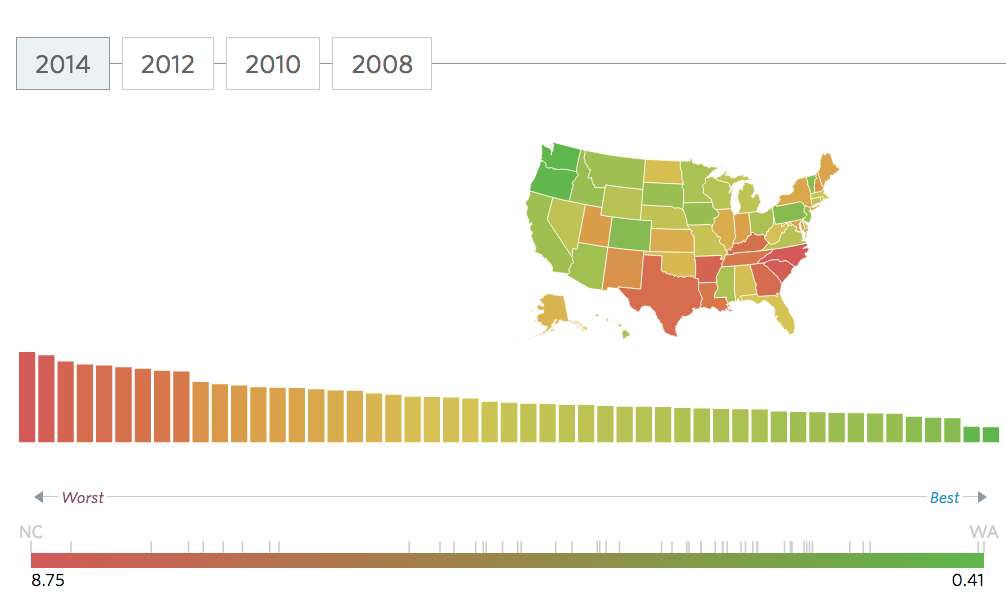
Recently, the PewTrust Research Center published the Election Performance Index (EPI), a comprehensive evaluation of the electoral system in all of the nation’s 50 states – including the District of Columbia. The study took into account 17 key indicators.

The EPI covers the 2008, 2010, 2012 and 2014 elections, measuring variables related to the problems faced by voters with disabilities, the availability of an online register, the voting of military personnel deployed abroad, voter turnout and the number of voters registered.  

These indicators reflect how several states have managed to improve their performance during elections, particularly when it comes to online registration and waiting times to vote.  

-          Online registration: Since 2008 there has been a steady increase of the number of states that offer this option to voters. This year, only two states (Washington and Arizona) opted for this technology upgrade. Today, over 20 states offer an online solution for voter registration and the update of their data.  

-          Voters with disabilities: During the past 4 elections, the District of Columbia, Mississippi and Alabama polled over 20% in the EPI when it came to voters who were unable to vote due to an illness or disability, due to the lack of proper conditions at the polling places and of solutions offered by the voting system.  

-          Voter turnout: The EPI reflects two important changes. On the one hand, during the 2008 and 2012 general elections, voter turnout did not surpass 80%, while for the midterm elections of 2010 and 2014 this index dropped to a mere 58%.  

These indicators, in addition to others in the study, show how states can continue to develop their electoral systems to offer voters more accessibility, transparency and security. These variables could be improved by the use of technology, leading to a stronger democracy. 

Wednesday, January 11, 2012

How E-Voting Makes Voting More Accessible to Disabled Citizens


Source: everystockphoto

There are many arguments as to why some form of electronic voting ("e-voting") would be an advantageous over paper ballots with manual counting. While some benefits are related to efficiency and accuracy, it is also important to guarantee inclusion, allowing voting as many people as possible. This includes people with disabilities.

Everyone Has the Right to Vote
Although certainly there are some variations across the different nations and political systems, it is generally accepted by most modern countries that everyone old enough has the right to vote. It doesn’t matter if you are rich or poor, male or female, black or white.
But, the fact is that a manual election system is not as inclusive as some people may think, as it casts out an important demographic group. And people with disabilities have just as much a right to vote as their more able-bodied fellow citizens.

Machines for all types of disabilities
Companies such as Smartmatic have in its product portfolio equipment models (series SAES-4000/4200, SAES-3300/3700  and SAES-1800) that allow people with disabilities to exercise their right to vote in an efficient and independent way. The SAES-4000 series is a voting machine with a Braille touch screen, that’s also compliant to any height, shape and can be adjusted for people who use wheelchairs.

These equipments are designed to address limitations as low or null literacy, ocular diseases, mental illness, and motor problems, among other conditions. Voters are led throughout the voting process with built-in audio system to cast their votes independently. For this, the machines have a control that includes headphones, buttons with different shapes, colors and sizes, Braille display and a device to sip and puff for voters with mobility limitations.

Additionally, for people with limited proficiency in the official language of the country, computers can be easily enabled in multiple languages, if the electoral power of the country so requires.

The Smartmatic voting machines also come with the added advantage of being able to read ballots for multiple precincts, improving efficiency. Each polling place will only need one scanner, quite unlike previous elections where any split precinct would require more than one electronic scanner for the ballots.

Assisting Other Disabilities and Physical Challenges
Say, for example, that someone struggles with dexterity and fine movements. This person would then have difficulty holding a pencil steadily enough to mark some paper ballots. The introduction of a large touch screen once again could aid in this, as the voting "buttons" could be considerably larger. Other solutions, like audio votes, may also be appropriate.

Just as technology is used in the classroom, in the workplace, and in the home to facilitate the experiences of people with disabilities, the voting process should be no different. E-voting can help.

Monday, February 7, 2011

Disabled voters love E-Voting


E-voting machines mean greater access, independence, and privacy for millions of disabled voters. Some of them have described the experience of using next generation voting machines as a “new freedom” and cherish the “privilege to have that right to privacy for the first time.”