Showing posts with label United States. Show all posts

Thursday, October 31, 2024

How Hand Count Harms the Electoral Process


Automation has woven itself into the warp and woof of modern life, with people trusting algorithms to manage everything from banking to medicine to transportation. It’s difficult to imagine why anyone would even advocate for a return to manual counting in elections. Yet, as the 2024 presidential race draws near, pockets of the country are pushing for just that: hand-counting ballots. While this may seem like a throwback to a simpler time, the reality is that hand-counting is inefficient, error-prone, and dangerously outdated. Here’s why it’s a bad idea.

Humans Are Prone to Error

Hand-counting votes might seem like a logical solution, especially for small jurisdictions. But when scaled up to the size of a state or the entire nation, the problems become glaring. Research consistently shows that human error is a major factor when it comes to manual tallying. A study by Rice University found that when participants counted just 120 ballots by hand, they only got it right 58 percent of the time. Over 40 percent of the time, they made mistakes. Imagine such error rate applied to the millions of ballots cast in a presidential election. The result would be chaos.

In Nye County, Nevada, this nightmare did become reality. In 2022, the county clerk, Mark Kampf, an election denier, attempted to discard machine counts in favor of a "parallel" hand-counting effort. By the end of the process, Kampf admitted to a staggering 25 percent error rate in the hand-count.

Volunteers, many of whom had no experience with election processes, struggled to reconcile the tallying process. The delay in the process didn’t just cause frustration; it led to legal intervention, with the state Supreme Court stepping in to stop the hand-counting due to concerns over early vote leaks.

This episode wasn’t an isolated incident, but an eye-opening example of what happens when we expect humans to do a job that’s far better suited for machines.

The Time and Cost of Manual Counting

Hand-counting is also a costly and time-consuming endeavor. It’s a far cry from the efficiency of electronic systems. In Texas’ Gillespie County, a hand-count of Republican primary ballots stretched into a grueling 24-hour marathon with 200 volunteers working through the night. Despite their best efforts, the final tally was riddled with errors that required additional corrections. The cost? Double what it would have been for machine tabulation.

Shasta County, California, offers yet another cautionary tale. In 2022, officials there explored the idea of hand-counting ballots. But after a cost analysis, the plan was shelved. Hand-counting would have required more than 1,200 additional workers and cost the county an estimated $1.6 million — a price tag that made the process economically unfeasible for the

small county (population of 180,663). At the end of the day, manual counting isn’t just logistically infeasible challenge; it’s a financial burden on taxpayers as well.

The Perils of Slow Results

The risk with hand-counting isn’t just about errors or costs; it’s about the delays in announcing election results. Every moment that goes by without a clear outcome invites uncertainty and distrust. In a world where misinformation spreads like wildfire, the longer it takes to tally votes, the more time there is for conspiracy theories to take root. The prolonged process in places like Texas and Nevada only fuels this distrust, making it harder to maintain the public’s faith in the electoral system.

The slow pace of manual counting also makes it vulnerable to interference. In the Nye County example, where election officials failed to meet deadlines due to slow counting, early vote tallies were leaked — a situation that could easily compromise election integrity. The longer the process drags on, the more room there is for outside forces to sow doubt or confusion.

Why Machines Are Better

E-voting systems, which are already in place across the United States, offer a far more efficient and reliable alternative. These systems are designed to count ballots quickly and accurately, with much less risk of human error. In fact, these systems are regularly audited through post-election checks, where small samples of ballots are manually recounted to ensure machine accuracy.

Election officials have long known that human beings are not suited for tasks that require repetitive precision. Machines, on the other hand, excel in this domain, making them a far better choice for large-scale elections. A well-designed tabulation system can count ballots faster, more accurately, and at a much lower cost than any hand-counting process could hope to achieve.

The push to hand-count ballots is a misguided effort driven more by misinformation than by logic. While manual counting might work for a few small, local elections, scaling it up is a recipe for disaster. It’s slow, expensive, and riddled with human error — exactly the opposite of what we need in a fast-paced, high-stakes democratic process.

Machine tabulation isn’t just more effective — it’s the future of voting.

Thursday, March 5, 2020

Los Angeles County debuts its new voting system with good grade


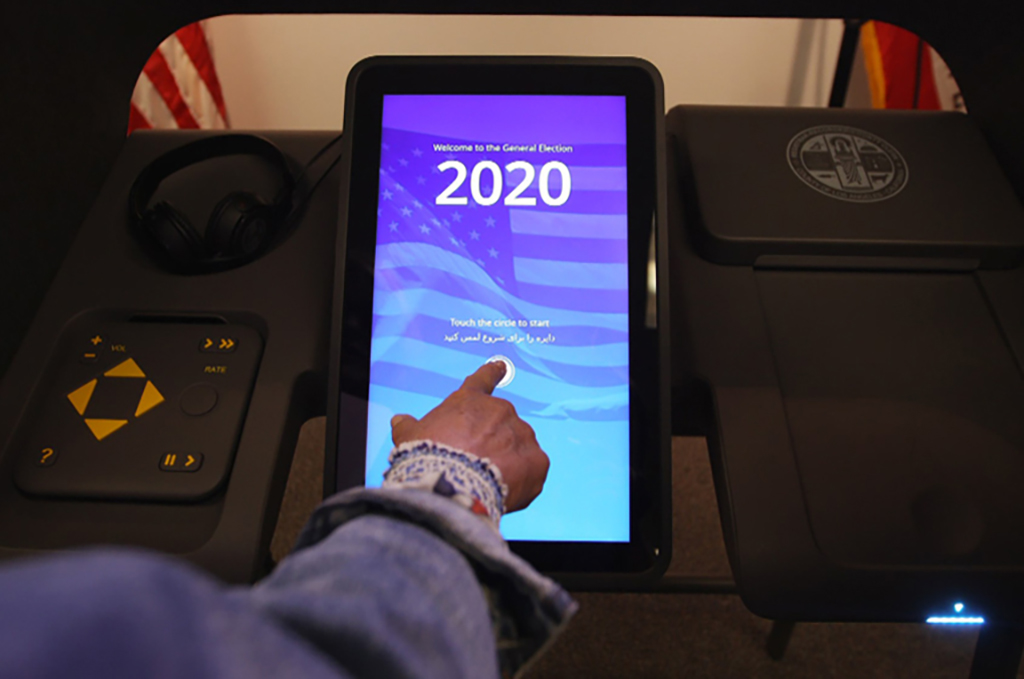
Los Angeles County launched a new voting system during the primaries held yesterday in California. Overall, the debut of this much anticipated new system was successful. 

The vast majority of voters decided to use the new Vote Centers to cast their ballot in person. As of March 5, the county website shows a 60% of the ballots were cast using the Ballot Marking Devices deployed across the country. The remaining 40% voted by mail. 

The debut was not perfect. “There is no question that many voters faced long wait times and challenges in voting in Los Angeles County on Tuesday,” said Dean Logan, Registrar-Recorder County Clerk, referring to the issues presented with the check in process. On Election Night, Logan had explained that the poll book used to register voters created bottle necks and long lines. He clarified, though, that the voting machines worked properly. 

The Voting Solutions for All People (VSAP) took ten years in the make. It was a long process of consultation and testing that involved all stakeholders, from young voters, to politicians, academics, and above all, the disabled community. With VSAP now active, the county can put to rest the Inkavote that had been deploying since 1968.

An important feature of the VSAP is that voters can cast their vote from any of the nearly 1,000 voting centers spread across the county. Voters can simply go where it suits them. In addition, voting days were expanded to 29 to facilitate participation. For those who preferred to vote at home, mail-in-ballots were sent to every voter.

With VSAP, the county made available the innovative Interactive Sample Ballot (IBS), which is a sort of a hybrid system between online voting and traditional polling-center voting. Voters were able to preselect their preferences on their smartphones or tablets, and then go to a polling place to cast their vote. This optional voting method reduces lines at polling stations and improves voter convenience.

To protect the integrity of the votes, VSAP offered robust security mechanisms. In fact, by complying with the California voting standards, it exceeded those utilized in most other US states. 

After its debut, VSAP will be implemented across the county for the November 2020 presidential elections. With cybersecurity paranoia running high, this will be the ultimate test for VSAP.

Thursday, July 26, 2018

How badly were US elections hacked?


After the 2016 elections in the United States, a large number of headlines appeared regarding the supposed intervention of hackers to manipulate the voting system and to change the will of the citizens.

Thousands of web pages spread fake news through social networks and generated misinformation. Today we know that Russian nationals were indicted for conducting an illegal "information warfare" effort to disrupt the 2016 presidential election, possibly distorting the popularity of Donald Trump’s candidacy.

The real impact of such campaigns is hard to measure: recent research on the real effects found that most voters reading such fake news already supported their candidate. In other words, they somehow favored voting for President Trump; or they already were not too enthusiastic to vote for Hillary Clinton.

Besides this media campaign, there were the hacking events against the Democratic National Committee and the Democratic Congressional Campaign Committee. Also, there were attempts to attack state election offices where intruders sought to hack voter registration databases in Illinois and Arizona.

However, there is no evidence to proof that even a single voting machine was hacked. As the article Voting machines in America are reassuringly hard to hack; Voter rolls are not from The Economist points out, “Rigorous software studies and vote counting revealed that there is no evidence of manipulation, change or votes eliminated during the 2016 elections”.

Also, this article from Politico: What we know about Russia’s election hacking states that “Officials from the Department of Homeland Security say they haven’t seen any evidence of digital tampering with election organizations, individuals or systems — though that doesn’t rule out some broader effort to undermine public faith in the U.S. political system or sow unrest”.

Although voting machines were not hacked and not a single vote was changed, Russia might be still trying. “It is 2018, and we continue to see Russian targeting of American society in ways that could affect our midterm elections” Director of National Intelligence Dan Coats stated. Therefore, the US should be seeking to adopt a more secure, accessible and reliable election system – one that can only be achieved through modernization.

One out of three US voters have concerns about the accuracy and reliability of the voting technology used at their polling place, and one out of five Americans who voted in the 2016 presidential contest do not fully trust that the national election results were tabulated accurately. However, they also propose a clear solution: eight out of 10 voters believe that upgrading the nation’s voting technology will strengthen and build trust in future elections –a fact the administration and its commissions should not ignore.

To achieve this, there is not only the matter of modernizing and upgrading the voting systems. All sectors involved (media, government, NGOs) and influencers should debunk the myths that are generated daily by false news that seek to warp democracy in the United States. By the way, here an Expert advise on how to fight fake news.

Wednesday, September 28, 2016

Election Performance Index: a thorough analysis of the North American electoral system


As Election Day draws nearer, poll-related studies continue to be conducted, throwing further light on the current state of American elections and the developments it had undergone.

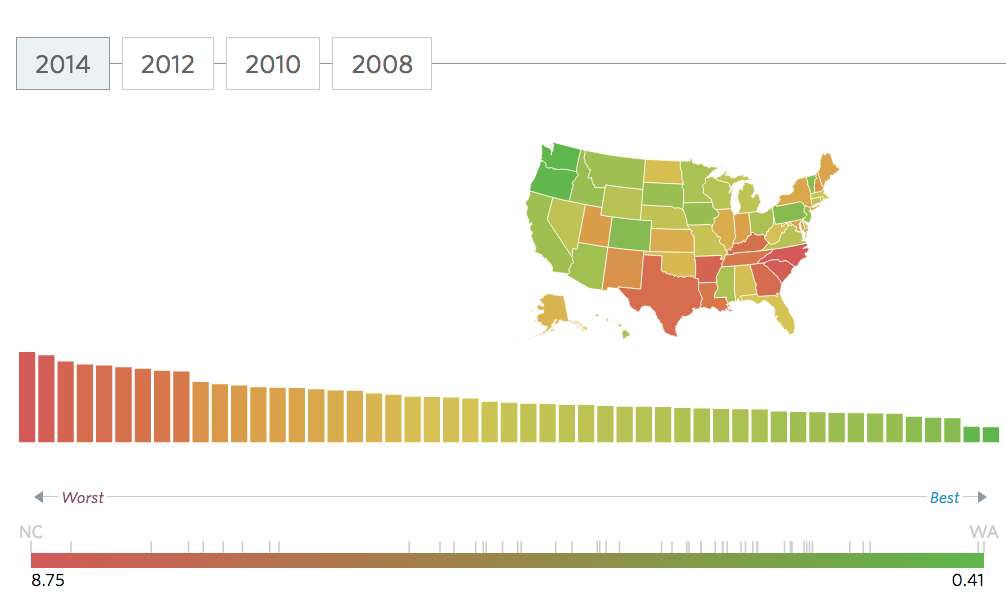
Recently, the PewTrust Research Center published the Election Performance Index (EPI), a comprehensive evaluation of the electoral system in all of the nation’s 50 states – including the District of Columbia. The study took into account 17 key indicators.

The EPI covers the 2008, 2010, 2012 and 2014 elections, measuring variables related to the problems faced by voters with disabilities, the availability of an online register, the voting of military personnel deployed abroad, voter turnout and the number of voters registered.  

These indicators reflect how several states have managed to improve their performance during elections, particularly when it comes to online registration and waiting times to vote.  

-          Online registration: Since 2008 there has been a steady increase of the number of states that offer this option to voters. This year, only two states (Washington and Arizona) opted for this technology upgrade. Today, over 20 states offer an online solution for voter registration and the update of their data.  

-          Voters with disabilities: During the past 4 elections, the District of Columbia, Mississippi and Alabama polled over 20% in the EPI when it came to voters who were unable to vote due to an illness or disability, due to the lack of proper conditions at the polling places and of solutions offered by the voting system.  

-          Voter turnout: The EPI reflects two important changes. On the one hand, during the 2008 and 2012 general elections, voter turnout did not surpass 80%, while for the midterm elections of 2010 and 2014 this index dropped to a mere 58%.  

These indicators, in addition to others in the study, show how states can continue to develop their electoral systems to offer voters more accessibility, transparency and security. These variables could be improved by the use of technology, leading to a stronger democracy. 

Monday, June 6, 2016

At least 43 states in the USA will use obsolete technology in the 2016 elections


It is estimated that during the 2016 elections at least 43 states in the USA will use voting machines that are already obsolete. In a world where technology is used almost daily, one must wonder why Americans must choose a President using devices running software from the year 2000.  

According to a study published by the Brennan Center most these machines are nearing the end of their useful life, placing the elections at risk by being prone to failures that could generate long lineups, or the loss of votes.   

Lawrence Norden,  Deputy Director of the centre and co-author of the study, wonders how one can think there are no risks  in running elections with technology designed in the 90’s. “No one expects a computer to work optimally for over 10 years”. 

The warnings in the report come at a moment when voter turnout in the US has decreased, given the long lines at the polls and the limited access certain sectors of society have to the vote.  

Before the 2016 primaries, Smartmatic – the leading elections company with experience in five continents – published a research paper that highlights the shortcomings of the American electoral system. 

The general opinion of those consulted shows that the current voting system is inefficient and discourages voters. On their part, Hispanics showed their concern about language barriers, considering that implementing new systems could increase turnout.  

These studies are just the tip of the iceberg of a subject that is gaining traction with American citizens, who see that an obsolete voting system could affect the vision their country projects worldwide about the strength of its democracy. For them, this situation could be reverted easily with the introduction of new and better technology.