Showing posts with label Online Voting. Show all posts

Tuesday, March 7, 2023

Historic: Estonian online voting system breaches 50% mark in recent Estonia polls


Estonia achieved a new world record last week when 51% of voters chose to participate in the 2023 parliamentary elections via the Internet. Since its introduction in 2005 in the Baltic nation, online voting has been enjoying a steady growth.

This success of internet voting is particularly impressive in light of the major cyber-attack in 2007 that disrupted Estonia’s government services and raised concerns about the security of its digital infrastructure. Despite the harrowing episode, Estonians have taken to the idea of digital democracy, a testament to how thoroughly the Estonian government had implemented its recovery measures, including its cyber deterrence strategies.

The increasing sophistication of the technology itself is also driving adoption. Online voting systems are now even more secure, transparent, and inclusive than ever before. They use advanced encryption and other security measures to make the system more impregnable against hacking and other cyber-attacks. The technology is designed to ensure voter anonymity and to be tamper-proof.

As the technology matures, more people are realizing the immense benefits of the internet as voting modality -- flexible, accessible, inclusive, user-friendly. Anywhere there is an internet connection, citizens can vote using a device of their choice. While online voting used to only appeal to tech-savvy young people, it now is increasingly within the reach of voters of all ages and backgrounds.

The COVID-19 pandemic proved to be another accelerant to i-Voting adoption. Online voting offers a safe and convenient alternative to in-person voting, a fact that has made it more attractive to citizens who may be hesitant to participate in traditional voting systems during a widespread health crisis.

The 2023 Estonia experience is a strong tell for the readiness of voters to embrace even more modern voting modalities such as the internet. Despite important questions around security and accessibility that need to be addressed, election commissions around the world would do well to take a page from the success of Estonia and start exploring how online voting technology could help them conduct better elections.

Wednesday, November 17, 2021

The Philippines inches closer to internet voting


The Philippines’ Commission on Elections (Comelec) recently conducted test runs for internet voting as part of its mandate to enfranchise Filipino voters abroad.

In a statement, Comelec said that the test runs were part of a study on the use of internet-based technology for overseas voting. The poll body is expressly allowed by law to explore other modes or systems using automated election system.

The initiative saw thousands of overseas Filipino voters signing up to vote in simulated polls using three different platforms from competing voting companies. The tests yielded varying degrees of success in terms of participation with one provider hitting a record 64% voter turnout.

“This looks promising because traditionally we never go beyond 50 percent when it comes to voters who actually voted for overseas voting. Historically, it’s always been below 40 percent,” according to Sonia Bea Wee-Lozada, a Comelec official in charge of overseas voting.

“So, that’s how we are imagining it especially for overseas voting. Seafarers who may not be on land during the voting period, the internet voting system would be very much convenient and efficient for them,” she said.

Internet voting is expected to boost turnout as it enables voters to participate from anywhere there is a stable internet connection, a boon for overseas Filipinos who may not be able to take a day off to visit an embassy or consulate or find it expensive to travel to the nearest polling place.

The Comelec hopes that the test runs will be able to determine the operational and technical feasibility of conducting overseas voting using internet-based systems and gather data on technical specifications of the internet voting solutions currently being used in different countries.

The data gathered from these activities will inform COMELEC’s recommendatory report or policy proposal to Congress, which is expected to pass an enabling law for internet voting to be used in the midterm elections of 2025.

There are an estimated 2.8 million Filipinos working all over the world pumping back some $4 billion to their home country’s economy annually. Owing to this sector’s significant contribution to the country’s GDP, the Philippine government has accorded special status to overseas workers and has relentlessly been seeking ways to improve delivery of services to them, including making voting easier.

The success of online voting for overseas Filipinos could likewise prove to be the impetus for Comelec to consider rolling the system out to the rest of the country. Advocates are convinced that internet voting could make elections in this archipelagic country of more than 7,000 islands easier, safer, and cheaper.

Thursday, July 18, 2019

Switzerland cancels online voting pilot


The Swiss government has suspended the use of online voting just months ahead of this year’ October parliamentary elections. The reason: technical flaws in the two e-voting systems currently in use.

Following a cross-party campaign, critics have announced they will be proposing a five-year moratorium on e-voting trials. The setback is concerning. Stalling technology development could prove detrimental to election participation, as many voters had grown accustomed to the convenience of online voting.

Even though the Swiss Federal Council has been a champion of e-voting, and has trialed remote electronic polling across multiple cantons for the past fifteen years, the deferral should not come as a surprise.

A similar situation occurred back in 2015, when the Swiss government decided to deny access to e-voting technology in nine cantons before the parliamentary polls.

The e-voting context is relevant

·      Only about 2% of Swiss voters cast their ballots online. The Federal Council proposed (2018) to make e-voting a third regular voting channel, alongside in-person and postal votes.
·      While the Council has suggested that two-thirds of cantons should offer it, opponents launched a people's initiative asking for a 5-year moratorium on e-voting and ongoing trials.
·      Over 90% of voters in Switzerland vote by mail. A more common voting option than in most countries around the world. Public trust in the postal service and other voting providers is usually at high levels.
·      A technical flaw concerning universal verifiability was discovered in the e-voting system that the postal service planned to roll out in four cantons for this year’s parliamentary elections.
·      Swiss Post acknowledged that the error in the source code had already been identified in 2017, and pledged to develop a new, updated version available from 2020. Regretfully, the correction was not fully implemented by the technology provider.
·      The government and the cantonal authorities are currently evaluating possible ways to move forward.

Affected audiences

The government resolution to drop online voting directly affects the expatriate community. The Organisation of the Swiss Abroad (OSA) has requested the government to reconsider the decision and has taken a leading role in the introduction of electronic voting.

Over 180,000 Swiss expatriates are eligible to take part in votes. They usually vote by post, but the organization has denounced that the envelopes often arrive too late, violating their right to fully participate in the elections. Remo Gysin, OSA President, has called for online voting to be made available for all Swiss expatriates by 2021.

On the other hand, other stakeholders affected by the decision are the cantons which were subscribed e-voting. For instance, Fribourg, Neuchâtel, and Thurgau will seek compensation after spending money on making the system ready to voters in the October elections.

Monday, January 14, 2019

From Estonia to Zimbabwe, a multicultural call for e-voting


The urge to have free, fair and credible elections in African democracies has prompted most leaders to go out of their way to seek drastic measure to achieve that quality. The 2018 general elections in Zimbabwe are a demonstration of how desperate African states need to embrace e-voting system in their elections.

Envisaging the impasse in the elections, the transition government led by President Mnangagwa reached out to Estonia in search for help in exploring the possibility of implementing an e-voting system. This was a strategy aimed at enabling Zimbabweans who were living in the diaspora to take part in the national elections from the comfort of their destinations.

A timely solution for the diaspora

There had been a long clamour by the diaspora-based Zimbabweans demanding an opportunity to exercise their democratic right, even when they are away from their country. Desperate efforts had been done but remained futile following a conspicuous lack of political goodwill especially from the former regime of President Robert Mugabe.

This has come at a time when several Zimbabweans living in diaspora had to undertake a rigorous effort appealing to the government through law courts for the facilitation of their participation in the political processes. Although this quest would not be successful after a long struggle, the agitators never relented. After the ouster of the former president from power, the effort took a different turn as the current president reach out to Estonia for help.

President Emmerson Mnangagwa guaranteed Zimbabweans who inhabited in the US that his organization would investigate the likelihood of executing e-voting sooner rather than later as had been revealed by the state-run news office. Mnangagwa, in the interim, met Estonian Prime Minister Juri Ratas on the side-lines of the UNGA to examine a series of issues including how Zimbabwe could take advantage of Estonian information on e-voting.

Estonia’s online voting leadership

The agreement between the two leaders entailed that the ICT officials would be outsourced from Estonia to educate the ICT officials in Zimbabwe who would then disseminate similar education to the citizens living in the diaspora to undertake the process.

Estonia remains a hub of technology and e-voting. It has already offered guidance to help a series of countries including Afghanistan and Pakistan in curbing election irregularities during their general elections.

Estonia is in truth a pioneer with ICT advancements. In the case of Zimbabwe, the president evaluated three basic zones of collaboration with the Baltic country, e-wellbeing, e-administration, and e-voting. e-Voting is gradually becoming a solution highly sought after by developing countries to eliminate electoral fraud in their political regimes. 

Sunday, October 29, 2017

Estonia’s online voting is a worldwide reference


More than a decade after its first experience using election technology, Estonia continues to spearhead online voting,
During the recent local elections held on October 15, Estonia set a new record for online participation. 186,034 citizens voted via the Internet, 39% more than the number recorded in the last elections of 2015.
This election was also unique because, for the first time, the Parliament allowed young people between 16 and 17 years old to participate. On the other hand, 27% more citizens over 55 years old voted using online voting, compared to previous elections.
By facilitating voting to people with reduced mobility, residents in border cities and abroad, online voting has proven effective in enfranchise citizenry.
Estonia is well ahead the curve when it comes to e-governance. It is probably the only country in the world where 99% of the public services are available online 24/7.
The commitment of government officials to efficiency and transparency is behind the successful adoption of technology. The video below shows Estonia’s Prime Minister Taavi Rõivas promoting online voting.

Tuesday, October 11, 2016

New votings apps seen to increase turnout

For decades, election authorities in the U.S. have been puzzled over the dwindling number of people turning out for elections. Whether the reason is lack of interest, or lack of access to polling centers, or some other impediment, low voter turnout is proving to be such a pain point that it has received the attention of various sectors, even the developer community.

Recently, several innovative mobile applications have been released that aim to smooth the voter registration process. One such notable app is the appropriately-named Register to Vote which allows citizens in California, Pennsylvania, Missouri, Arizona, Colorado, and Massachusetts to register simply by scanning their state IDs.  It promises to complete the whole process in thirty seconds. The app’s most obvious benefit is the elimination of the cumbersome step of having to physically go to a registration to sign up.

Another app takes the chatbot approach in helping voters register.  HelloVote allows voters simply enter their mobile phone number on this site, or text HELLO to 384–387, and the app takes them through the filling out the voter registration form for their state.  Some states allow direct electronic submissions while some states require voters to fill out a form that HelloVote will send back via via email or snail mail for later submission to the local electoral body.

It’s not as if anyone is likely to forget when Election Day is. But sometimes little nudge helps in to actually go out and cast that vote. TurboVote provides that impetus by sending text and email reminders. Voters get a notification the day before election day complete with ballot information and information on the nearest polling center.   What’s even more interesting is the TurboVote Challenge, which get top companies and leading organizations into a a nonpartisan advocacy to increase voter participation.


Reversing the voter turnout downtrend is a tall order yet innovation could provide just the needed spark to get voters trooping back to the polling centers.

Wednesday, September 28, 2016

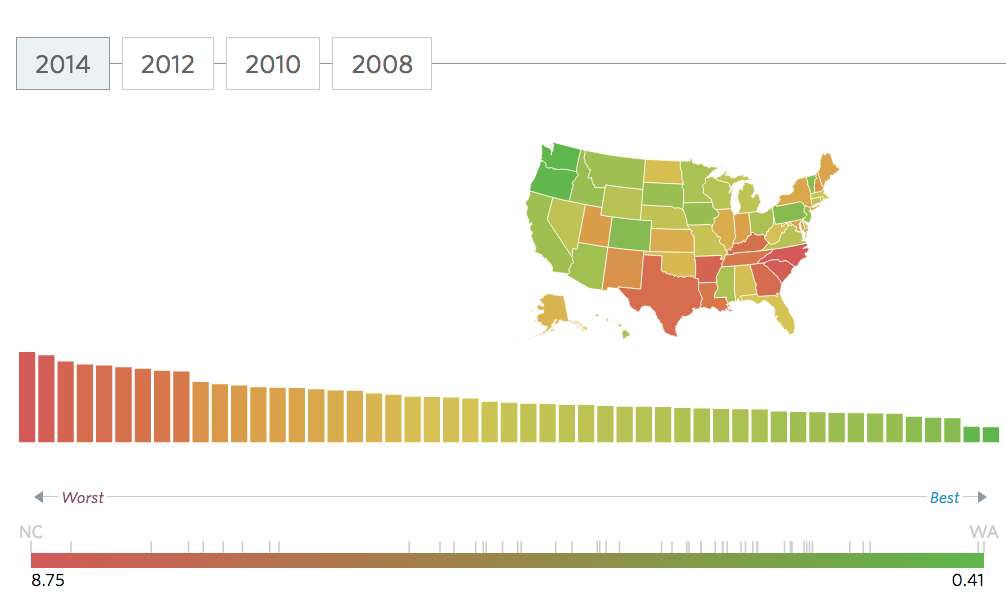
Election Performance Index: a thorough analysis of the North American electoral system


As Election Day draws nearer, poll-related studies continue to be conducted, throwing further light on the current state of American elections and the developments it had undergone.

Recently, the PewTrust Research Center published the Election Performance Index (EPI), a comprehensive evaluation of the electoral system in all of the nation’s 50 states – including the District of Columbia. The study took into account 17 key indicators.

The EPI covers the 2008, 2010, 2012 and 2014 elections, measuring variables related to the problems faced by voters with disabilities, the availability of an online register, the voting of military personnel deployed abroad, voter turnout and the number of voters registered.  

These indicators reflect how several states have managed to improve their performance during elections, particularly when it comes to online registration and waiting times to vote.  

-          Online registration: Since 2008 there has been a steady increase of the number of states that offer this option to voters. This year, only two states (Washington and Arizona) opted for this technology upgrade. Today, over 20 states offer an online solution for voter registration and the update of their data.  

-          Voters with disabilities: During the past 4 elections, the District of Columbia, Mississippi and Alabama polled over 20% in the EPI when it came to voters who were unable to vote due to an illness or disability, due to the lack of proper conditions at the polling places and of solutions offered by the voting system.  

-          Voter turnout: The EPI reflects two important changes. On the one hand, during the 2008 and 2012 general elections, voter turnout did not surpass 80%, while for the midterm elections of 2010 and 2014 this index dropped to a mere 58%.  

These indicators, in addition to others in the study, show how states can continue to develop their electoral systems to offer voters more accessibility, transparency and security. These variables could be improved by the use of technology, leading to a stronger democracy. 

Monday, June 20, 2016

Estonia: More young people studying e-governance every day


Estonia is today a world reference when talking about digital democracy. The government offers a vast array of online services, which its citizens access through a digital ID card. It is also worth noting that the online voting technology they have developed has been used in several processes in different countries.   

To keep developing these platforms that have improved the quality of life of millions, several of the country’s public and private universities are offering top-of-the-line courses to young people interested in innovation and e-governance.  

One of these institutions is the Tallinn University of Technology  (TUT), which offers a MSc in technology and e-governance services to native and foreign students. This degree, driven by the public and private sectors, is a priority for the country, and the subject is openly promoted by president Toomas Hendrik Ilves, a confessed lover of innovative technology. 
At TUT, students with ideas for first-level startups want to be ambassadors for Estonia’s electoral technology and make it known worldwide. One of them is Crystal LaGrone from Oklahoma, USA, who is halfway through the masters program and wants to bring e-voting technology back home.   

LaGrone came to Estonia as a visitor and quickly became interested in innovation. “I’ve discovered great advances in IT, particularly Internet voting”. 

This student, who had no previous IT experience, thinks that Internet voting could strengthen democracy and increase turnout in the United States. In her opinion, the masters program offers extensive knowledge on how to found a modern state – the transition to e-government, its development and management. 

Her objective is clear: returning to the United States to improve e-voting systems, a tool designed to strengthen democracy by preventing paper-based fraud.  “If we managed to take a man to the moon and bring him back, Internet voting couldn’t possibly be as hard”. 

Monday, June 6, 2016

At least 43 states in the USA will use obsolete technology in the 2016 elections


It is estimated that during the 2016 elections at least 43 states in the USA will use voting machines that are already obsolete. In a world where technology is used almost daily, one must wonder why Americans must choose a President using devices running software from the year 2000.  

According to a study published by the Brennan Center most these machines are nearing the end of their useful life, placing the elections at risk by being prone to failures that could generate long lineups, or the loss of votes.   

Lawrence Norden,  Deputy Director of the centre and co-author of the study, wonders how one can think there are no risks  in running elections with technology designed in the 90’s. “No one expects a computer to work optimally for over 10 years”. 

The warnings in the report come at a moment when voter turnout in the US has decreased, given the long lines at the polls and the limited access certain sectors of society have to the vote.  

Before the 2016 primaries, Smartmatic – the leading elections company with experience in five continents – published a research paper that highlights the shortcomings of the American electoral system. 

The general opinion of those consulted shows that the current voting system is inefficient and discourages voters. On their part, Hispanics showed their concern about language barriers, considering that implementing new systems could increase turnout.  

These studies are just the tip of the iceberg of a subject that is gaining traction with American citizens, who see that an obsolete voting system could affect the vision their country projects worldwide about the strength of its democracy. For them, this situation could be reverted easily with the introduction of new and better technology.