Showing posts with label Philippines. Show all posts
Tuesday, August 4, 2020
Anti-technology groups endangering future of elections in the Philippines
In May 2022, voters in Philippines will go to the polls to elect their new president and other national and local officials. For this general election, the country is set to use for a fifth time its automated election system, which it has adopted with great success since 2010.
Popular opinion is that automation has resulted in a pronounced improvement in the credibility of elections, which had historically been marred by controversies due to the slow manual count and the susceptibility of the manual system to manipulation. In a 2019 survey, leading pollster Pulse Asia found out that 84% of Filipinos trusted election results and an overwhelming 91% wanted automated voting in future elections.
But despite the success of poll automation, some small yet loud anti-technology groups have somehow influenced lawmakers to file bills seeking to junk the system in favor of a so-called hybrid method, which purportedly blends manual and automated modes of voting.
Election experts have been quick to warn that hybrid is just manual elections couched in technology speak, and represents a significant downgrade that could set off a dangerous backslide toward the dark ages of the flawed manual elections.
Election watchdog Democracy Watch said in statement that “adopting a hybrid vote counting system in 2022 is a step back for the Philippines in its journey towards transparent and credible elections.”
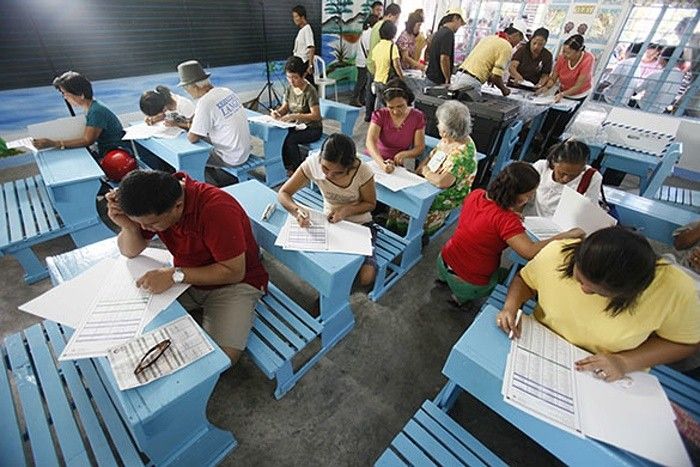
During an end-to-end demonstration at a school in Cavite, a province just south of the capital Manila, the system proved unreliable and inefficient. Witnesses were one in observing that moving back to manual counting, as implied under the hybrid system, would be a significant setback.
After the test, lawmaker Rep. Edgar Erice stated “I don’t think [hybrid system] feasible. The test run was not successful. I maintain that the law requires automation both in the precinct voting and transmission.”
Fredenil Castro, Capiz Representative and then House electoral reforms committee chair, stated that the hybrid system test was "miserably [unsuccessful] to even closely match the advantages of a fully-automated election."
As the elections inch closer, all eyes are on the Philippine legislature as it debates the hybrid bill. Will it pass a law supplanting automated polls in favor of the untried hybrid system thereby risking a regression to the benighted days of manual? Or will it uphold the successes of the past four elections and retain the automated election system to ensure that the 2022 polls are marked with transparency and credibility?
The future of Philippine democracy may very well be hinged on this.
Monday, May 6, 2019
270 poll workers dead: The high cost of Indonesia’s manual vote counting
Counting votes by hand has always been backbreaking work.
But for some poll workers in Indonesia, it proved to be deadly as well. Some
270 election workers have passed away from exhaustion, under pressure to finish
the counting two weeks after the country’s general elections.
Arief Priyo Susanto, spokesman of Indonesia’s General
Elections Commission (KPU), said that most deaths were due to fatigue-related
illnesses caused by long hours of work counting of ballot papers by hand. In
addition to the fatalities, some 1,878 other staff had fallen ill.
Although the polls were generally peaceful, the counting is
far from over. Authorities do not expect to conclude vote counting and
officially announce winners until May 22.
The tragedy underscores the even uglier side of manual
elections and should jolt election managers everywhere to rethink their
counting systems. What makes this even more tragic is that modern voting
technology already exists that could spare poll workers from this ordeal.
The poll workers were up against something daunting --- for
the first time in Indonesia’s history, authorities combined presidential,
parliamentary and regional elections in one day. This meant that the 6 million
poll workers had to prepare 810,000 polling stations to receive 193 million
eligible voters. Roughly 245,000 candidates were vying for more than 20,000
national and local legislative seats.
In addition to the sheer size of the election, the geography
further complicated logistics. Indonesia is an archipelago comprising some
18,000 islands across an area of 1.9 million square kilometers.
According to
the Lowy Institute, an Australian think-tank, these were "one of the most
complicated single-day elections in global history."
As two other Asian countries have shown, technology has the
power to improve election administration. in Indonesia.
India, which has been automating vote counting since 2004,
is now using some 1.2 million electronic voting machines to make their
elections better. For this year’s Lok Sabha election, 10 million election
officials are conducting the largest democratic elections in the world. 840
eligible voters are scheduled to participate in a voting exercise that will span
throughout five weeks. Once voting is done, votes will be electronically
counted, consolidated and announced. Though there is still room for
improvement, India has managed to make voting more accessible and transparent
relying on technology.
The Philippines will head to the polls on May 13 to hold
midterm elections. This archipelago, which is a neighbor of Indonesia, has
automated vote counting since 2010 with impressive results. Some 90,000 optical
scanners are used to digitize and count the votes of some 63 million voters.
Since the Philippines began automating vote counting, poll workers have
benefited from simplified processes and reduced hours of operation. Also, by
minimizing the role poll workers play on election day, they have become less
vulnerable to bribing and coercion.
The tragedy has thrown Indonesia’s General Elections
Commission in the spotlight. It must take decisive measures to prevent another
tragedy of this magnitude from ever happening again. Better processes, better
organization, and better technology have become urgent imperatives.
India and the Philippines show this can be done.
Labels:
elections automation,
india,
indonesia,
Philippines,
Poll workers
Monday, May 9, 2016
The Philippines sets a new record in election automation
On May 9, over 45 million voters elected
their local and national Philippine authorities using 92,509 vote counting
machines. This represents the largest deployment of vote counting machines ever.
The
Commission on Elections (Comelec) and Smartmatic, who previously organized
successful elections in 2010 and 2013, showed again the enormous benefits of
election automation and what the technology deployed could mean for the
Asia-Pacific region.
To guarantee transparency and the proper
functioning of the system on Election Day, several audits, certifications and
tests took place during the months leading up to the election. The source code
used to run the automated platform was audited for 8 months by a group of
experts, which included political party representatives, election watchdogs and
authorities. Additionally, a US-based
company SLI Global certified that the source code worked as intended.
During the voting hours every voter was
given a vote receipt showing the selections registered by the system to allow
him/her to make sure it was correctly registered. It is important to note that,
as a paper-based system, the voter-marked ballot was already a robust auditing
mechanism.
This extremely high level of auditability allowed
political organizations to check that results matched the will of the voters at
the polls, and accept the outcome of the elections.
With this new successful election, the Philippines
proved that they are at the leading front of the worldwide trend towards election
technology adoption.
The future of democracy is digital, and the
Philippines have proved it.
Thursday, January 29, 2015
Election automation in the Philippines: a snapshot
![]() |
| taesmileland / freedigitalphotos |
One of the latest controversial episodes occurred on Tuesday's hearing of the House Committee on Suffrage and Electoral Reforms. Under intense questioning from Caloocan Representative Edgar Erice, Carlos Suarez, vice president of Indra Sistemas – a bidding company–, was forced to admit that the Government of Spain, through Sociedad Estatal de Participaciones Industriales (SEPI), is the single largest shareholder of the company.
Erice pressed Indra on the ownership issue saying that he is concerned that a foreign state might interfere with the country's elections. "I understand that it's normal for states to have a majority stake in companies. But it's a different matter if we're talking about elections" he said. Erice was seconded by Rep. Terry Ridon, who said that the matter is "cause for concern", and added:"We don’t want foreign state entities to be involved in our elections". If authorities reach a consensus over the inconvenience of risking a foreign government intervene in national elections, the Philippines would be left with only one choice to choose from the British company Smartmatic.
Besides the Spanish company, controversy is also spilling over to Comelec. For example, two poll watch coalitions accused Comelec of signing a “midnight deal” with Smartmatic for the diagnostic tests of the same 80,000 PCOS machines Smartmatic sold to the country in 2012. The fact that no contract has actually been signed to this day between Comelec and Smartmatic for such services, prompted authorities to slam those poll watchdog groups.
It is a shame that the institution responsible for the previous two successful automated elections has become the target of such aggressive campaign. Public administration should be thoroughly scrutinized, but unfounded accusations hurt the democratic ecosystem as a whole. Comelec has made mistakes in the past, just like any other public institution in the world, but it should also be credited for increasing the speed with which results are delivered and reducing post-electoral violence since automation.
The latest two automated elections (2010-2013) have also been constantly hammered with criticism by certain watchdogs. However, these groups have not escaped controversy. Local Rep. Fredenil Castro, who chairs the House Committee on Suffrage and Electoral Reforms, scolded certain "interested" groups and "self-styled" experts for creating unwarranted "noise" about the ongoing bid even as he appealed to such groups not to cast aspersion upon Comelec's integrity and credibility. "We should not allow this thing to happen because elections are of critical importance to our democracy.”
Addressing Evita Jimenez of AES Watch, which had been critical of the automated election system, Castro appealed for the group to refrain from attacking the Comelec without substantiation. "Unless they can substantiate their accusations, I urge these groups to exercise restraint in coming out with statements that put the Comelec in a bad light" Castro said, and concluded: "The Comelec safeguards our elections. If these groups attack the integrity of the Comelec, then it weakens out democracy because it places the legitimacy of the government under a cloud of suspicion."
Controversy is still in the air, and is likely to grow as the bidding processes gets into more decisive stages. We’ll keep you posted with another snapshot in due time.
Subscribe to:
Posts (Atom)

