Showing posts with label electronic vote america. Show all posts

Thursday, March 5, 2020

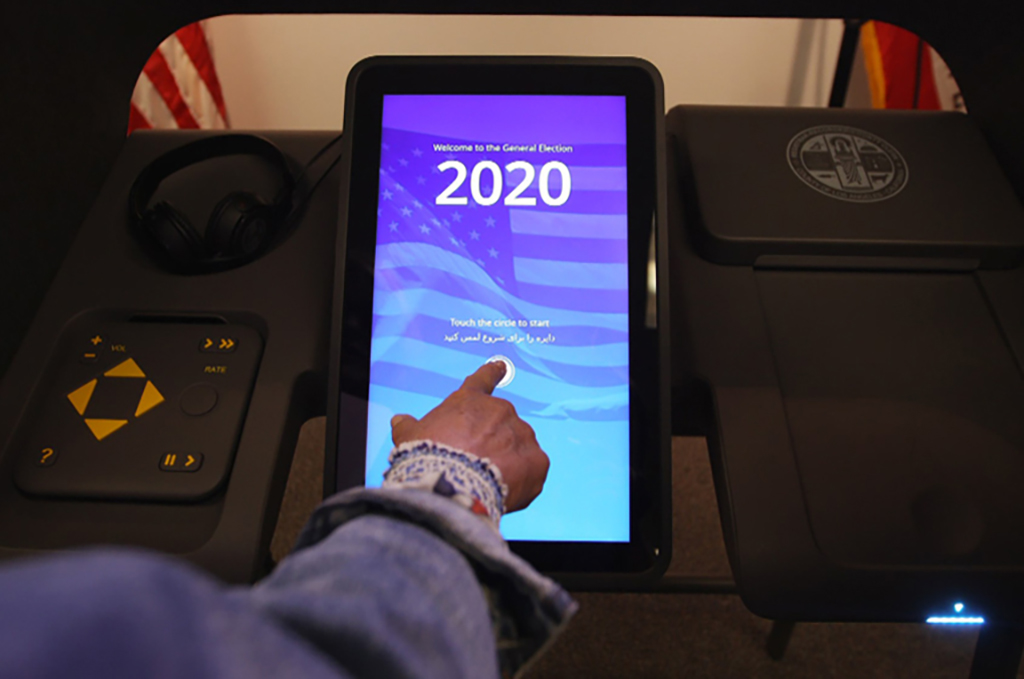
Los Angeles County debuts its new voting system with good grade


Los Angeles County launched a new voting system during the primaries held yesterday in California. Overall, the debut of this much anticipated new system was successful. 

The vast majority of voters decided to use the new Vote Centers to cast their ballot in person. As of March 5, the county website shows a 60% of the ballots were cast using the Ballot Marking Devices deployed across the country. The remaining 40% voted by mail. 

The debut was not perfect. “There is no question that many voters faced long wait times and challenges in voting in Los Angeles County on Tuesday,” said Dean Logan, Registrar-Recorder County Clerk, referring to the issues presented with the check in process. On Election Night, Logan had explained that the poll book used to register voters created bottle necks and long lines. He clarified, though, that the voting machines worked properly. 

The Voting Solutions for All People (VSAP) took ten years in the make. It was a long process of consultation and testing that involved all stakeholders, from young voters, to politicians, academics, and above all, the disabled community. With VSAP now active, the county can put to rest the Inkavote that had been deploying since 1968.

An important feature of the VSAP is that voters can cast their vote from any of the nearly 1,000 voting centers spread across the county. Voters can simply go where it suits them. In addition, voting days were expanded to 29 to facilitate participation. For those who preferred to vote at home, mail-in-ballots were sent to every voter.

With VSAP, the county made available the innovative Interactive Sample Ballot (IBS), which is a sort of a hybrid system between online voting and traditional polling-center voting. Voters were able to preselect their preferences on their smartphones or tablets, and then go to a polling place to cast their vote. This optional voting method reduces lines at polling stations and improves voter convenience.

To protect the integrity of the votes, VSAP offered robust security mechanisms. In fact, by complying with the California voting standards, it exceeded those utilized in most other US states. 

After its debut, VSAP will be implemented across the county for the November 2020 presidential elections. With cybersecurity paranoia running high, this will be the ultimate test for VSAP.

Wednesday, August 5, 2015

Expanding Electronic Voter Registration in USA for 2016

The political system in the United States can be incredibly difficult to understand at the best of times, partly because of the way that the responsibilities are handled. Even though the federal election to decide the next President of the United States clearly has ramifications on a national level, the particulars of registering to vote and casting a ballot are not handled at the federal level. Each state has its own control over how voters cast their ballots and how those ballots are tabulated.

Although the United States of America is widely regarded as one of the most advanced countries in terms of the strength of its democracy, it is still curious to see that, when it comes to elections, it still lags behind many other nations that may otherwise be seen as less developed. In many states, voters must still register manually with a physical paper form. It's time the United States moved into the 21st century.

As a positive, several states have moved ahead with some form of electronic voter registration and this trend has continued to pick up momentum. The pace at which electronic and even online voter registration has been adopted in the different states has steadily quickened in recent years. In 2008, only Arizona and Washington State offered online voter registration, but that group grew to some 20 states by 2014.

Looking ahead to the general election next year, more states will be reportedly adding themselves to that list. This follows the recommendation put forth by the Presidential Commission on Election Administration in January, which pushed for reducing wait times at polling places and the “continued expansion of online voter registration” for the nation's citizens.

A prime example of this is happening in the state of Ohio where a bill was introduced in February to set up an online voter registration system that could serve as a suitable replacement for the traditional paper forms. Introduced by Republican Senator Frank LaRose, Senate Bill 63 could help to “improve the accuracy of our voter records, reduce the potential for fraud and protect voter privacy, all while reducing costs to the taxpayer.”

In addition to improved accuracy and reduced costs, the introduction and implementation of an online voter registration system in Ohio could help to get more people registered to vote. In turn, this would bolster voter turnout and provide for a more representative government. Heading into 2016, a total of 27 states, plus the District of Columbia, have either implemented or passed legislation for online voter registration.

While the bill has not yet been signed into law in Ohio, it has received overwhelming support by the Ohio senate, which passed Senate Bill 63 by a vote of 31 to 1. The next step is for the bill to be debated and passed by the Ohio House of Representatives. The vote on the bill may not occur in the House until later this fall.

Contemplating even higher levels of security, the state of New Mexico is considering the introduction of biometric voter authentication as part of its voter registration and verification process. This simultaneously decreases the likelihood of fraud and increases access to the universal right to suffrage for individuals who may otherwise be challenged to produce reliable photo identification. More side-lined groups like the Hispanic and Latino community would benefit greatly from such a change.

That's still not all 50 states in the union, but significant progress continues to be made in an environment where change has not come easily. 

Thursday, June 25, 2015

The burgeoning growth of online voter registration in the United States


Electronic voting technology can be implemented along nearly every step along the democratic process, empowering citizens to exercise their right to vote in the most convenient, most secure and most efficient manner possible. There are direct-recording electronic (DRE) voting machines, for instance, that offer many profound benefits over traditional paper ballots. There are machines for recording, counting and tabulating the ballots to provide the results as quickly and as accurately as possible.

But even before a voter can make his mark on the ballot, digital or otherwise, he must first be properly identified, authenticated and registered to vote. In the United States, online voter registration is quickly rising in popularity across many of the states, making the democratic process more relevant and more approachable particularly for younger demographics. The growth has been pronounced and it has been rapid.

As recently as 2008, online voter registration was only available in Arizona and Washington State, providing this access to just 4 percent of all eligible voters across the country. Just six years later in 2014, these figures skyrocketed to the point where a total of 20 states were offering online voter registration to its residents, accounting for nearly half of all eligible voters in the United States. These include California, Connecticut, Illinois, Kansas, Minnesota, Nevada, New York, Oregon and more. It is also being used in the District of Columbia.

The growth is continuing in more states too as Hawaii, Massachusetts, Nebraska and West Virginia are all already working on implementing online systems of their own for the purposes of voter registration. More recently, just last month, Florida Governor Rick Scott approved the use of online voter registration in the Sunshine State. The motion received “overwhelming bipartisan support.” Six other states have also approved similar legislation for the development of online voter registration systems. In Florida's case, the mandate calls for its implementation by October 2017.

In its review of online voter registration systems in the United States, the Pew Charitable Trusts found that online registration was more cost-effective than traditional paper registration, it provided for more accurate voter rolls, it was more secure, and it was more convenient for voters to register too. The United States Presidential Commission on Electoral Administration similarly supports the use of online voter registration. It's no wonder that it has strong support in many of the remaining states without such a system, like New Jersey. Other states, like South Dakota, have less enthusiastic.

The bigger push toward online voter registration in the United States is both mirrored and further demonstrated in other countries around the world as well. A prime example of this is the recent general election in the United Kingdom. The overwhelming majority of voters in this election chose to register via digital means rather than through paper forms. 

This was more clearly demonstrated on the biggest registration day, April 19, when nearly 470,000 people registered to vote electronically compared to just under 16,000 chose to do so with paper forms. All said, 7.1 million people in the United Kingdom used the online voter registration system since its original introduction last summer. Just 2.1 million people used postal registration over the same period of time.

Even as the popularity and deployment of electronic voting machines continue to expand throughout the world, it is important to recognize the need to update the entirety of the democratic process. The ongoing rise of online voter registration in the United States demonstrates promise and gives hope.

Wednesday, January 12, 2011

The electronic vote in the United States


There are over 3,140 electoral mechanisms in the United States, which are used according to the decisions made by the local authorities of each state. The country has timidly started to shift between the old fashioned electoral systems, to new modern, efficient, secure and reliable electoral technology systems.